
Bio Bright
Hardware Development
2025


Client
BioBright Ltd is a UK-based technology company developing an advanced water and atmospheric monitoring system designed to capture high-fidelity environmental data across real-world settings, enabling organisations to better understand exposure, air quality, and environmental risk factors.
Challenge
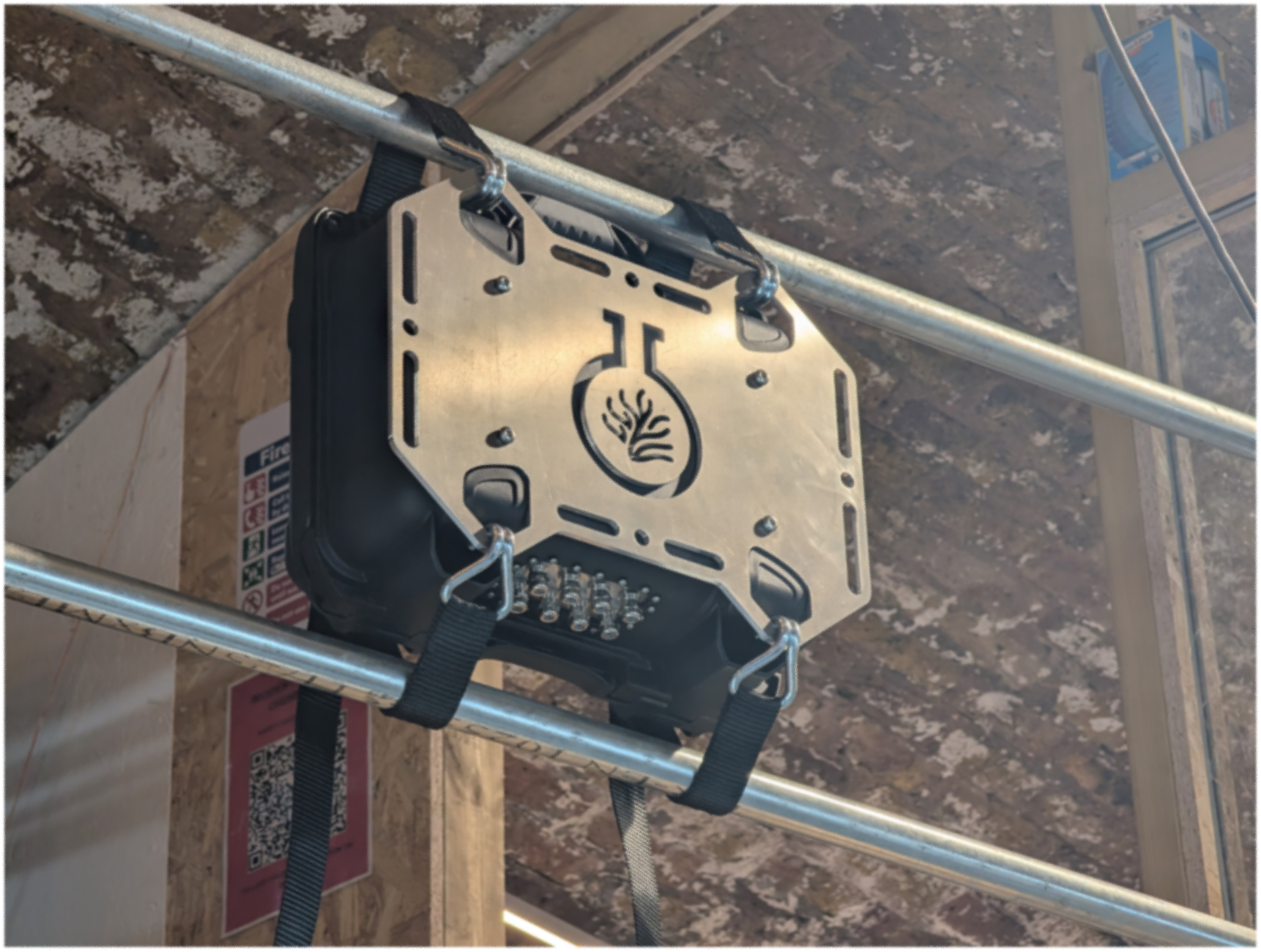
BioBright approached Wyzer Innovation Services to support the development of a robust prototype enclosure for their monitoring system.
The purpose of this phase was not to produce a fully manufacturable, production-ready housing, but instead to create a TRL5 prototype casing that enables real-world validation of the electronics, and sensor data.
BioBright required a pragmatic and cost-effective hardware solution that could:
- Protect and contain their electronics and sensors.
- Allow flexible sensor placement and cable routing.
- Be securely mounted to an indoor or outdoor wall.
- Deliver a single working prototype suitable for early environmental trials.
Electronics, firmware, and software remained fully within BioBright’s internal scope, with Wyzer’s role focused specifically on the casing, mounting system, and integration of the electronics provided.

Approach
Wyzer Innovation Services followed an iterative, evidence-based approach aligned with the prototype-focused nature of the project (TRL5), prioritising speed, robustness, adaptability and budget efficiency.
1. Design Framework & Requirements Alignment
Building on BioBright’s specifications, Wyzer captured all mechanical, environmental and operational requirements for the enclosure.
2. Selection & Modification of Off-the-Shelf Enclosures
To maximise value within the available budget, Wyzer evaluated a range of off-the-shelf casings suitable for:
- Electronics housing
- Environmental protection (ingress resistance, thermal behaviour, durability)
Wyzer selected two off-the-shelf enclosures and developed a modification plan that enabled:
- Cable gland integration for all wired sensors
- A direct air-exposed port for one environmental sensor
- Mechanical reinforcements and internal fixings to secure BioBright’s electronics assemblies
3. Wall Mounting System Design
- Provide a rigid mounting surface
- Enable lockable attachment of the enclosure to the bracket
- Allow simple “screw-to-wall” installation
- Withstand long-term environmental exposure
Wyzer also prepared mechanical specifications to ensure seamless handover and integration with the electronics supplied by BioBright.
4. Prototype Build & Integration
Wyzer fabricated the modified enclosure system and executed the physical integration of BioBright’s hardware, ensuring:
- Controlled cable routing
- Correct positioning of sensors for accurate sampling
- Alignment with real-world environmental test conditions
This phase produced one fully assembled prototype ready for deployment.
Deliverables
- One TRL5 prototype enclosure including electronics housing, sensor compartment, cable management and environmental sensor port.
- Modified wall-mounting system allowing secure lockable installation.
- Mechanical design, drawings and specifications for all modifications.
- Integration supports ensuring compatibility with BioBright’s electronics, firmware, and sensor architecture.
This prototype now forms the foundation for the next stage of BioBright’s hardware evolution, moving from proof-of-function to a refined, production-ready system.
Impact
This collaboration provided BioBright with a fit-for-purpose prototype enclosure system that supports the primary objective of this development phase: environmental and sensor data validation under real operating conditions.
The project successfully balanced speed, robustness and cost efficiency, enabling BioBright to:
- Begin real-world environmental testing sooner
- Validate sensor performance and data capture pipelines
- Refine requirements ahead of future industrial design and DFM work
- Progress toward a scalable, manufacturable enclosure in later phases
Socials